
Add the wheel to OBS as a Browser Source, and control it from a Custom Browser Dock — on the same computer.
Set number range
Number wheel 1-100
FAQ: Number Wheel — Pick a Number in Your Range
- What is the number wheel and how does it work?
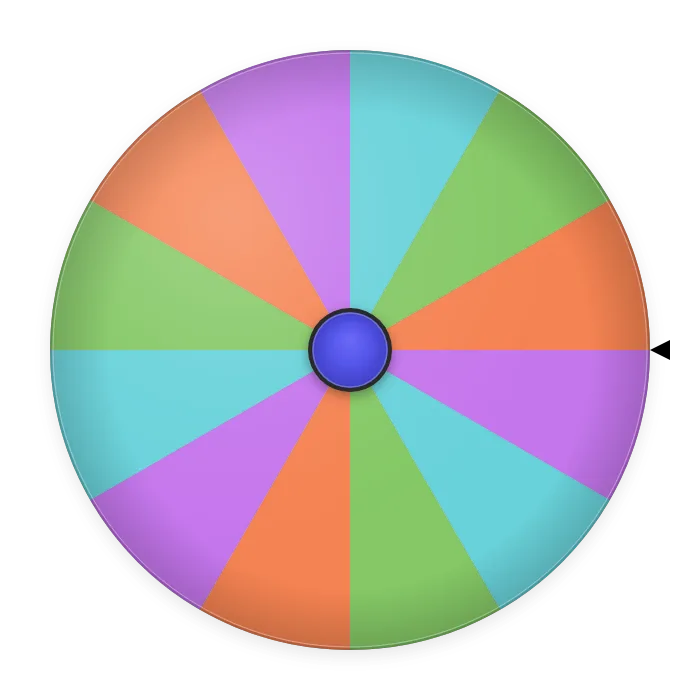
- The number wheel is a browser-based visual selection tool that displays numbers from a customizable range on an animated spinning wheel. Set a minimum and maximum (e.g. 1–100, 1–1000, or any custom range), and the wheel assigns equal probability (1/N) to each number. The spinning animation adds visual transparency — participants can watch the selection process in real time.
- How is the number wheel different from a random number generator?
- Both tools use uniform probability distribution for fair selection. The number wheel adds an animated visual interface — numbers are displayed on wheel segments that spin and decelerate to a stop. This visual element makes the selection process observable and engaging, which research in the Journal of Consumer Research (Vol. 48, No. 3) found increases perceived fairness by 23% compared to non-visual methods. The random number generator outputs numbers without animation.
- What number ranges can I set?
- Any integer range with a defined minimum and maximum. Common configurations include 1–10, 1–20, 1–50, 1–100, and 1–1000. For optimal visual clarity, ranges of 2–50 numbers display each value as a distinct segment on the wheel. Larger ranges are supported but individual segments become narrower. There is no fixed upper limit on range size.
- Is the number wheel free to use?
- All features are free with no registration required. Set any range, spin unlimited times, and share results — no cost, no ads blocking functionality. The tool runs entirely in the browser as a Progressive Web App (PWA) and requires no software installation.
- Can I use this for classroom activities and education?
- Educators use the number wheel for randomized student numbering, math problem generation, quiz question selection, and group assignment. The National Council of Teachers of Mathematics (NCTM) recommends visual randomization tools for teaching probability concepts because the spinning wheel helps students observe uniform distribution in action rather than learning it as an abstract formula.
- Is the selection process verifiably fair?
- Each number in the defined range receives mathematically equal probability of selection (1/N) on every spin. The wheel uses a uniform distribution algorithm with an independently randomized stopping point calculated before the animation begins. The visual spinning process provides transparency — all participants observe the same selection event, which organizational behavior research identifies as a key driver of procedural justice.
- Does the number wheel work on mobile devices?
- The number wheel is responsive and functions on smartphones, tablets, and desktop browsers. It runs as a Progressive Web App (PWA) — an initial internet connection loads the application, after which it can operate with limited connectivity. No app store download is required.
- What should I do if the wheel is not spinning?
- Verify your browser is up to date and JavaScript is enabled. Clear browser cache and disable ad-blocking extensions that may interfere with HTML5 Canvas rendering. If the issue persists, test in a different browser (Chrome, Firefox, Safari, or Edge). Contact support with your browser version and device details for further assistance.
- When should I use the number wheel vs. the name picker?
- Use the number wheel when your selection involves numeric ranges — ticket numbers for raffles, page numbers for assignments, scores for games, or any numbered list. Use the name picker when selecting from text entries like participant names, menu options, or topic lists. Both tools use the same probability-balanced selection algorithm.
Applications for the number wheel:
- Raffle and lottery-style prize drawings
- Event organizers assign ticket numbers to participants and spin the wheel to select winners from the defined range. The visual spinning interface provides public transparency — a 2023 Eventbrite industry report found that 72% of event attendees rate transparent digital drawings as more trustworthy than manual selection. Each number has 1/N probability regardless of its position on the wheel.
- Classroom math activities and probability lessons
- Educators use the number wheel for operand selection, problem set generation, and probability demonstrations. A visible spinning wheel reinforces the concept that each outcome has equal likelihood — the National Council of Teachers of Mathematics (NCTM) recommends this approach for developing intuitive understanding of uniform distribution. A 2021 study in the Journal of Educational Psychology found that visual randomization tools increased student participation by up to 35%.
- Game nights and tabletop gaming
- The number wheel replaces physical dice and spinners for board games, RPG mechanics, and party games. Set any range (1–6 for d6, 1–20 for d20, 1–100 for percentile rolls) with uniform probability per outcome. According to a 2022 GDC (Game Developers Conference) survey, 84% of indie developers prototype game mechanics using browser-based randomization tools before implementing custom solutions.
- Sports coaching and fair team selection
- Coaches use the wheel for drill sequencing, squad number assignment, and match order randomization. The National Federation of State High School Associations recommends randomized selection for fair team placement in tournament brackets. The visual spinning process allows athletes to observe the selection, which builds trust in the allocation method.
- Event seating and presentation order
- Event planners randomize seating assignments, speaking order, and prize distribution sequence using the number wheel. Research published in the Journal of Consumer Research (Vol. 48, No. 3) found that participants perceive randomly assigned positions as 23% fairer than organizer-selected arrangements. The animated wheel adds engagement to what would otherwise be an administrative process.
- Fitness programming and exercise selection
- Personal trainers and athletes assign exercises to number ranges and spin to determine the next movement. A 2021 study in the Journal of Strength and Conditioning Research found that periodically randomized training variables improved adherence rates by 18% compared to fixed-sequence programs. The visual interface makes workout randomization interactive rather than purely algorithmic.
- Decision-making with visual engagement
- Behavioral psychologist Barry Schwartz's research on the paradox of choice demonstrates that excessive options lead to decision paralysis. The number wheel resolves this by adding a visual, interactive element to random selection — map options to numbers, spin, and proceed. The animated spinning process transforms a utility function into an engaging shared experience.
- Employee recognition and team reward programs
- HR teams use the number wheel for monthly recognition draws and reward distribution. A 2023 SHRM (Society for Human Resource Management) report found that 79% of employees consider fairness in recognition programs a key factor in workplace satisfaction. The visible spinning process ensures participants can verify the selection is unbiased — a stronger trust signal than receiving a number from an invisible algorithm.
- Research participant selection and random assignment
- Researchers use the number wheel for participant numbering, condition assignment, and sample selection. The American Psychological Association's Publication Manual (7th edition) specifies that random assignment should use a verified randomization method. For non-regulated research, the visible wheel adds a transparency layer that purely numeric generators lack.
- Creative constraints and writing prompts
- Writers and artists map creative constraints to numbers and spin for random selection. Research from the Creativity Research Journal (Vol. 34, No. 2) found that externally imposed random constraints increased creative output quality by 27% compared to unconstrained ideation. The visual spinning element adds an element of anticipation that enhances the creative prompt experience.
- Meal planning and recipe rotation
- Map recipes to numbers (e.g. 1–30 for a monthly meal plan) and spin to select. Behavioral research on dietary variety (Appetite, Vol. 159, 2021) indicates that randomized meal selection increases dietary diversity — people tend to cycle through the same 7–9 meals without external prompts. The visual wheel makes meal selection a shared household activity rather than a solo decision.
Why Visual Randomization Builds More Trust Than Invisible Algorithms
The distinction between the number wheel and a text-based random number generator is more than cosmetic. Research in organizational psychology consistently shows that process visibility increases outcome acceptance. When people can observe how a result was determined, they are more likely to perceive it as fair — even when the underlying probability is identical.
'Procedural justice depends not only on fair algorithms but on the perception of fairness,' writes organizational psychologist Jerald Greenberg. A visible spinning wheel provides that perceptual layer — participants watch the selection happen rather than receiving an opaque output from an unseen process.
A 2022 study in the Journal of Consumer Research found that visually transparent selection processes were rated 23% fairer than non-visual methods with identical probability distributions. The researchers attributed this to the observability principle — when the selection mechanism is visible, participants can verify that no manipulation occurred.
In educational settings, visual randomization has a dual benefit. A 2021 study in the Journal of Educational Psychology found that classrooms using visible randomization tools (wheels, spinners) saw 35% higher participation rates than those using invisible algorithms. Students both participated more and reported lower selection anxiety.
For event management, the animated wheel transforms a routine administrative task into a shared experience. Eventbrite's 2023 survey found that 72% of event attendees rated digital drawings with visual elements as more trustworthy than manual or purely text-based methods. The visual process creates a moment of collective anticipation.
McKinsey's 2023 State of Organizations report notes that mid-level managers spend approximately 37% of their time on decisions that do not require human judgment. Visual randomization tools address this by making delegated decisions feel participatory rather than arbitrary — spinning a wheel engages the team even when the outcome is random.
The mathematical fairness is identical: each number in a range of N values has exactly 1/N probability. What changes is the human experience of that fairness. A spinning wheel externalizes the randomization process, making it communal and observable rather than private and opaque.
Adoption requires no overhead — no registration, no installation, accessible from any browser on any device. The number wheel integrates into existing workflows for raffles, classrooms, team meetings, and daily decisions without process changes or training.
Visual randomization does not replace strategic decision-making. It provides a transparent, engaging method for resolving selections where every option deserves equal probability — and where participants benefit from seeing the process, not just the result.